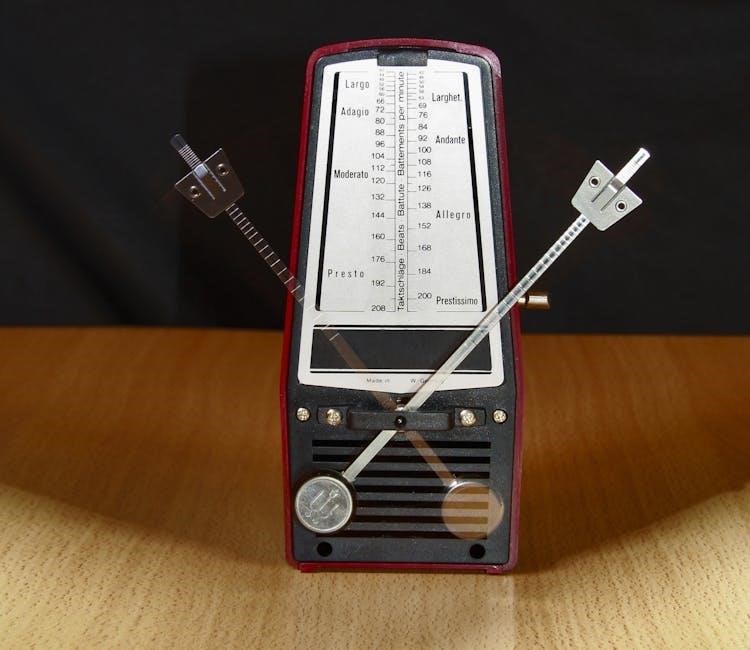
Theory and Design for Mechanical Measurements, 7th Edition by Richard S. Figliola, is available as a downloadable PDF, encompassing 44 pages of detailed engineering principles.
Overview of the 7th Edition
The 7th Edition of “Theory and Design for Mechanical Measurements” builds upon its established foundation, offering a comprehensive exploration of measurement principles and techniques. This edition, available in downloadable PDF format spanning 44 pages, delves into the theoretical underpinnings crucial for accurate and reliable data acquisition.
It serves as a valuable resource for students and professionals alike, covering a broad spectrum of topics within mechanical engineering design. The text references related works like “Mechanical Engineering Design” by Shigley and Mischke, and “Reliability Engineering,” highlighting the interconnectedness of measurement with broader engineering disciplines. The edition also touches upon advanced areas like wavefront metrology and microelectromechanical systems, demonstrating the evolving landscape of measurement technology.
Importance of Mechanical Measurements in Engineering
Mechanical measurements are fundamental to nearly all engineering disciplines, serving as the cornerstone for design validation, performance analysis, and process control. The 7th Edition of “Theory and Design for Mechanical Measurements,” accessible as a PDF, emphasizes this critical role. Accurate data acquisition, as detailed within the 44-page text, informs decisions across diverse fields like electromechanics, robotics, and biomechanics.
Understanding measurement principles is vital for assessing system behavior, ensuring product quality, and optimizing operational efficiency. The book’s coverage extends to specialized areas like viscosity measurement in non-Newtonian fluids and X-ray grating interferometry, showcasing the breadth of applications. Furthermore, the text’s connection to financial services, like Sparkasse’s online banking, illustrates the pervasive need for precise data in modern systems.
Historical Context of Measurement Techniques
The evolution of mechanical measurements is deeply intertwined with advancements in engineering and scientific understanding. While the 7th Edition of “Theory and Design for Mechanical Measurements” (available as a 44-page PDF) focuses on contemporary techniques, its foundations rest upon centuries of development. Early methods, though rudimentary, laid the groundwork for today’s sophisticated sensors and data acquisition systems.
The text implicitly acknowledges this history by building upon established principles. References to areas like wavefront metrology and porous medium flow suggest a progression from basic observation to complex analysis. Even seemingly unrelated mentions, such as Sparkasse’s digital services, demonstrate the ongoing refinement of measurement and control systems. The book’s scope, encompassing electromechanical systems and biomechanics, reflects a broadening of measurement applications over time.

II. Fundamental Concepts of Measurement Systems
Theory and Design for Mechanical Measurements, 7th Edition, details core concepts; understanding accuracy, precision, and error is crucial for reliable data acquisition and analysis.
Accuracy, Precision, and Resolution
Accuracy reflects how closely a measurement approaches the true value of the quantity being measured, a cornerstone detailed within Theory and Design for Mechanical Measurements, 7th Edition. Precision, conversely, indicates the repeatability or reproducibility of a measurement – how consistently the instrument returns the same value. A measurement system can be precise without being accurate, and vice versa.
Resolution defines the smallest increment that the measurement device can detect and display. Higher resolution doesn’t automatically guarantee greater accuracy or precision, but it allows for finer distinctions. The 7th edition emphasizes that understanding these distinctions is fundamental to selecting appropriate instruments and interpreting measurement data correctly. Proper calibration, as outlined in the text, is vital for maximizing both accuracy and precision, while resolution is limited by the instrument’s inherent capabilities.
Systematic and Random Errors
Systematic errors, consistently shifting measurements in one direction, are a key focus in Theory and Design for Mechanical Measurements, 7th Edition. These errors, often stemming from instrument flaws or calibration issues, can be mitigated through careful calibration and correction procedures. Conversely, random errors fluctuate unpredictably around the true value, inherent in the measurement process itself.
The 7th edition details how statistical analysis can be employed to minimize the impact of random errors by averaging multiple readings. Understanding the sources of both error types is crucial for accurate uncertainty analysis. Identifying and addressing systematic errors is paramount for achieving reliable results, while acknowledging and quantifying random errors provides a measure of the measurement’s precision. The text emphasizes a comprehensive approach to error management.
Calibration and Standards
Calibration and Standards are foundational elements detailed within Theory and Design for Mechanical Measurements, 7th Edition. The text underscores the necessity of comparing measurement devices against known, traceable standards to ensure accuracy. This process establishes a documented relationship between the instrument’s output and the true value of the measured quantity.
The 7th edition emphasizes the importance of utilizing national and international standards, providing a framework for consistent and reliable measurements across different locations and instruments. Proper calibration minimizes systematic errors and enhances the overall quality of data. Furthermore, the PDF resource likely covers calibration techniques for various sensors and transducers, ensuring engineers can effectively validate and maintain their measurement systems. Regular calibration is presented as a critical component of any robust measurement program.

III. Static and Dynamic Measurements
Theory and Design for Mechanical Measurements, 7th Edition, details principles for both static and dynamic measurements, crucial for analyzing system responses and behaviors.

Static Measurement Principles
Theory and Design for Mechanical Measurements, 7th Edition, establishes that static measurements involve conditions where measured quantities remain constant over time, allowing for precise determination of values. These principles form the foundation for understanding more complex dynamic scenarios.
The text likely delves into concepts like equilibrium, where net forces and moments are zero, enabling accurate readings. Static measurements rely on established standards and calibration techniques to minimize errors and ensure reliability. Understanding these foundational principles is essential for accurate data acquisition and subsequent analysis.
Furthermore, the 7th edition probably explores the importance of minimizing disturbances during static measurements to maintain stable conditions. This includes considerations for environmental factors and instrument stability, ultimately contributing to the overall accuracy and validity of the results obtained.
Dynamic Measurement Principles
Theory and Design for Mechanical Measurements, 7th Edition, likely details dynamic measurements as those involving quantities that change with time. These measurements necessitate understanding system response and the impact of time-varying forces and conditions.
The text probably explores concepts like frequency response, which characterizes a system’s behavior across different frequencies. Analyzing dynamic systems requires considering factors like damping, natural frequency, and excitation sources. Accurate dynamic measurements are crucial in fields like vibration analysis and control systems.
The 7th edition likely emphasizes the importance of selecting sensors and data acquisition systems capable of capturing rapidly changing signals without introducing significant distortion or phase shifts. Understanding these principles is vital for accurately characterizing dynamic phenomena and ensuring reliable results.
Response Time and Frequency Response
Theory and Design for Mechanical Measurements, 7th Edition, undoubtedly dedicates significant attention to response time and frequency response – critical aspects of dynamic measurements. Response time defines how quickly a measurement system reacts to changes in the measured variable, impacting its ability to capture transient events accurately.
Frequency response, conversely, describes a system’s behavior across a spectrum of frequencies. It’s essential for understanding how a system will respond to complex, oscillating inputs. The 7th edition likely details how to characterize these responses using techniques like step response analysis and Bode plots.
Selecting sensors and DAQ systems with appropriate response times and frequency ranges is paramount. The text likely emphasizes the trade-offs between these parameters and the importance of avoiding aliasing and signal distortion during data acquisition.

IV. Sensors and Transducers
Theory and Design for Mechanical Measurements, 7th Edition, explores various sensor types – mechanical, electrical, and optical – alongside transducer characteristics and signal conditioning methods.
Types of Sensors (Mechanical, Electrical, Optical)
Theory and Design for Mechanical Measurements, 7th Edition, details a comprehensive range of sensors crucial for modern engineering applications. Mechanical sensors, often utilizing strain gauges, directly respond to physical forces or displacements, providing robust and reliable measurements. Electrical sensors, including thermocouples and potentiometers, convert physical phenomena into electrical signals, offering high sensitivity and ease of integration with data acquisition systems.
Furthermore, the text explores optical sensors, leveraging principles of light modulation and detection for precise measurements of displacement, velocity, and temperature. These sensors are particularly valuable in applications requiring non-contact measurement techniques. The book likely delves into the specific advantages and limitations of each sensor type, guiding engineers in selecting the optimal sensor for a given measurement scenario. Consideration is given to electromechanical systems, microelectromechanical systems (MEMS), and biomechanics applications, showcasing the breadth of sensor technology.
Transducer Characteristics and Selection

Theory and Design for Mechanical Measurements, 7th Edition, emphasizes the critical importance of understanding transducer characteristics for accurate measurement systems. Key characteristics discussed likely include sensitivity, linearity, range, resolution, and frequency response. Selecting the appropriate transducer requires careful consideration of these parameters in relation to the specific measurement application.
The text probably details how to evaluate transducer performance based on specifications and calibration data. Factors such as operating environment, signal conditioning requirements, and cost also play a significant role in the selection process. The book likely covers transducers used in diverse fields like mechanical engineering design, reliability engineering, and even specialized areas like wavefront metrology, ensuring a holistic approach to transducer selection for optimal performance and reliability.
Signal Conditioning and Amplification
Theory and Design for Mechanical Measurements, 7th Edition, likely dedicates significant attention to signal conditioning and amplification techniques. These processes are crucial for converting raw transducer signals into usable data. The book probably explores methods for filtering noise, compensating for non-linearity, and adjusting signal levels to match the input range of data acquisition systems.
Discussions likely encompass various amplifier types, impedance matching, and common-mode rejection. Furthermore, the text probably addresses the importance of minimizing signal distortion and maintaining signal integrity throughout the conditioning process. Considering electromechanical systems and microelectromechanical systems, proper signal conditioning is vital for accurate measurements in diverse applications, from biomechanics to advanced wavefront metrology, ensuring reliable data analysis.

V. Measurement of Physical Quantities
Theory and Design for Mechanical Measurements, 7th Edition, details techniques for measuring crucial physical properties, including temperature, pressure, and fluid flow effectively.
Temperature Measurement Techniques
Theory and Design for Mechanical Measurements, 7th Edition, comprehensively explores diverse temperature measurement techniques, crucial for numerous engineering applications. The text likely details methods ranging from traditional thermocouples and resistance temperature detectors (RTDs) to more advanced infrared and fiber optic sensors.
Understanding the principles behind each technique – including their accuracy, response time, and suitability for different temperature ranges – is paramount. The 7th edition probably delves into the theoretical foundations governing heat transfer and thermal equilibrium, essential for interpreting measurement data correctly. Furthermore, it likely addresses signal conditioning and compensation methods to mitigate errors arising from lead wire resistance or environmental factors.
Practical considerations, such as sensor calibration and installation procedures, are also likely covered, ensuring reliable and accurate temperature measurements in various industrial and research settings. The downloadable PDF provides a solid foundation for selecting and implementing appropriate temperature measurement solutions.
Pressure Measurement Techniques
Theory and Design for Mechanical Measurements, 7th Edition, provides a thorough examination of various pressure measurement techniques vital across engineering disciplines. The text likely details methodologies including manometers, Bourdon tubes, diaphragm gauges, and modern electronic pressure transducers.
A core focus is understanding the underlying principles of static and dynamic pressure measurement, alongside considerations for absolute, gauge, and differential pressure readings. The 7th edition probably explores the theoretical basis of pressure sensing, encompassing fluid mechanics and transducer characteristics. It likely addresses signal conditioning, calibration procedures, and error analysis to ensure accurate results.
Furthermore, the downloadable PDF likely covers practical aspects like sensor selection based on pressure range, media compatibility, and environmental conditions. Discussions on minimizing errors due to temperature effects and hysteresis are also anticipated, providing a robust understanding of pressure measurement systems.
Flow Measurement Techniques
Theory and Design for Mechanical Measurements, 7th Edition, comprehensively covers diverse flow measurement techniques crucial for numerous engineering applications. The downloadable PDF likely details methods such as differential pressure flow meters (orifice plates, venturi tubes), turbine meters, positive displacement meters, and electromagnetic flow meters.
The text probably delves into the theoretical foundations of each technique, including fluid dynamics principles like Bernoulli’s equation and the continuity equation. It likely explores the impact of fluid properties (viscosity, density) on measurement accuracy and addresses calibration procedures for optimal performance.
Furthermore, the 7th edition likely examines modern techniques like ultrasonic flow meters and thermal mass flow meters, alongside signal processing considerations. Discussions on minimizing errors due to flow disturbances and pipe geometry are anticipated, providing a complete understanding of flow measurement systems.
VI. Data Acquisition and Analysis
Theory and Design for Mechanical Measurements, 7th Edition PDF, details Analog-to-Digital Conversion (ADC) and Data Acquisition Systems (DAQ) for signal processing and filtering.
Analog-to-Digital Conversion (ADC)
The Theory and Design for Mechanical Measurements, 7th Edition PDF, comprehensively covers Analog-to-Digital Conversion (ADC) as a crucial component of modern data acquisition systems. This process is fundamental to transforming continuous analog signals, originating from sensors and transducers, into discrete digital values that can be processed, stored, and analyzed by computers.
Understanding ADC principles is vital for accurate measurement; The text likely details various ADC architectures, including successive approximation, delta-sigma, and flash converters, outlining their respective strengths and weaknesses regarding speed, resolution, and cost. Key parameters such as sampling rate, quantization error, and resolution are thoroughly explained, enabling engineers to select the appropriate ADC for specific measurement applications.
Furthermore, the 7th edition likely explores practical considerations in ADC implementation, including anti-aliasing filtering to prevent signal distortion and the impact of noise on conversion accuracy. This detailed coverage ensures a solid foundation for designing and implementing effective data acquisition systems.
Data Acquisition Systems (DAQ)
The Theory and Design for Mechanical Measurements, 7th Edition PDF, dedicates significant attention to Data Acquisition Systems (DAQ), essential for translating real-world physical phenomena into usable digital data. These systems represent a complete chain, beginning with sensors and transducers, followed by signal conditioning, and culminating in analog-to-digital conversion and data processing.
The text likely details the architecture of typical DAQ systems, including components like signal amplifiers, filters, and multiplexers. It probably explores various DAQ hardware platforms, from standalone modules to plug-in cards for computers, discussing their capabilities and limitations. Software aspects, such as data acquisition programming and graphical user interface (GUI) development, are also likely covered.
A key focus will be on selecting appropriate DAQ components based on measurement requirements, considering factors like sampling rate, resolution, and channel count. The 7th edition likely emphasizes the importance of system calibration and error mitigation for achieving accurate and reliable measurements.
Signal Processing and Filtering
The Theory and Design for Mechanical Measurements, 7th Edition PDF, undoubtedly covers signal processing and filtering techniques crucial for extracting meaningful information from acquired data. Raw signals often contain noise and unwanted frequencies, necessitating filtering to enhance clarity and accuracy.
The text likely details various filter types – low-pass, high-pass, band-pass, and band-stop – explaining their characteristics and applications in mechanical measurements. It probably explores both analog and digital filter implementations, discussing their advantages and disadvantages. Furthermore, techniques like Fourier analysis, used for frequency domain signal analysis, are likely presented.
Signal conditioning, a precursor to filtering, is also likely addressed, including amplification, attenuation, and impedance matching. The 7th edition likely emphasizes the importance of selecting appropriate signal processing techniques based on the specific measurement application and noise characteristics.

VII. Uncertainty Analysis
Theory and Design for Mechanical Measurements, 7th Edition PDF, details uncertainty propagation, statistical analysis, and error budgets for robust tolerance design in measurements.
Propagation of Uncertainty
Propagation of Uncertainty, as detailed within Theory and Design for Mechanical Measurements, 7th Edition (available as a PDF), is a critical component of robust measurement analysis. This involves determining how uncertainties in individual measurements combine to affect the uncertainty in a calculated result.
The 7th edition likely covers methods for calculating uncertainty propagation through various mathematical operations, including addition, subtraction, multiplication, and division. Understanding these propagation rules is essential for accurately assessing the overall reliability of derived quantities.
The text probably emphasizes the importance of considering both systematic and random errors when performing uncertainty propagation. Furthermore, it likely provides practical examples and guidelines for applying these principles to real-world mechanical measurement scenarios, ensuring engineers can confidently interpret and utilize measurement data.
Statistical Analysis of Measurement Data
Statistical Analysis of Measurement Data, a core topic within Theory and Design for Mechanical Measurements, 7th Edition (accessible as a PDF), focuses on extracting meaningful insights from collected data. The textbook likely details methods for characterizing data distributions, calculating descriptive statistics like mean, median, and standard deviation, and assessing data variability.
The 7th edition probably explores techniques for hypothesis testing, confidence interval estimation, and regression analysis, enabling engineers to draw statistically valid conclusions from experimental results. It likely emphasizes the importance of identifying and handling outliers, and selecting appropriate statistical tests based on the data characteristics.
Furthermore, the text likely provides guidance on using statistical software packages to streamline data analysis and visualization, ensuring accurate and reliable interpretation of measurement outcomes.
Error Budgets and Tolerance Design
Error Budgets and Tolerance Design, as covered in Theory and Design for Mechanical Measurements, 7th Edition (available as a PDF), are crucial for ensuring product reliability and performance. The textbook likely details methods for systematically identifying and quantifying all potential sources of error in a measurement system.
It probably explains how to allocate acceptable error tolerances to individual components and processes, creating an overall error budget that guarantees the final measurement accuracy meets specified requirements. The 7th edition likely emphasizes the importance of considering both systematic and random errors during tolerance design.
Furthermore, the text likely explores techniques for sensitivity analysis, determining which parameters have the greatest impact on measurement uncertainty, and optimizing designs to minimize overall error.

VIII. Specific Measurement Applications
Theory and Design for Mechanical Measurements, 7th Edition (PDF), likely details applications like strain, vibration, and force measurements, utilizing techniques and principles discussed within.
Strain Measurement using Strain Gauges
Theory and Design for Mechanical Measurements, 7th Edition (in PDF format), would comprehensively cover strain measurement utilizing strain gauges – a crucial technique in mechanical engineering. This involves understanding how strain gauges, sensitive to mechanical deformation, convert strain into measurable electrical signals.
The text likely details gauge types, installation procedures (bonding agents, surface preparation), and wiring configurations (quarter, half, and full bridge circuits) to maximize sensitivity and temperature compensation. Furthermore, it would explain signal conditioning, calibration methods, and error analysis specific to strain gauge measurements.
Expect detailed discussions on interpreting strain gauge data to determine stress, material properties, and structural integrity under various loading conditions. The 7th edition PDF would likely include practical examples and case studies demonstrating real-world applications of strain gauge technology in diverse engineering fields.
Vibration Measurement and Analysis
Theory and Design for Mechanical Measurements, 7th Edition (available as a PDF), would dedicate significant attention to vibration measurement and analysis – a cornerstone of mechanical systems diagnostics. The material likely explores various vibration sensors, including accelerometers, velocity transducers, and displacement sensors, detailing their operating principles and selection criteria.
Expect a thorough treatment of signal processing techniques, such as Fourier analysis, to decompose complex vibration signals into their frequency components. This allows for identifying resonant frequencies, imbalances, and other fault indicators. The PDF would likely cover data acquisition systems (DAQ) used to capture vibration data and software tools for spectral analysis.
Furthermore, the text would likely discuss vibration isolation, damping techniques, and methods for predicting system behavior based on vibration characteristics, essential for designing robust and reliable mechanical systems.
Force and Torque Measurement
Theory and Design for Mechanical Measurements, 7th Edition (in PDF format), would comprehensively address force and torque measurement techniques. Expect detailed coverage of load cells – the primary transducers for these measurements – including different types like strain gauge-based, piezoelectric, and hydraulic load cells. The text would likely delve into their construction, calibration procedures, and error analysis.
The PDF would likely explore various mounting configurations and considerations for minimizing extraneous forces and moments. Signal conditioning and amplification techniques specific to force and torque signals would also be covered, alongside discussions on resolving issues like temperature compensation and hysteresis.
Applications in mechanical engineering design, such as structural analysis and machine performance evaluation, would be highlighted, demonstrating the practical relevance of accurate force and torque measurements.